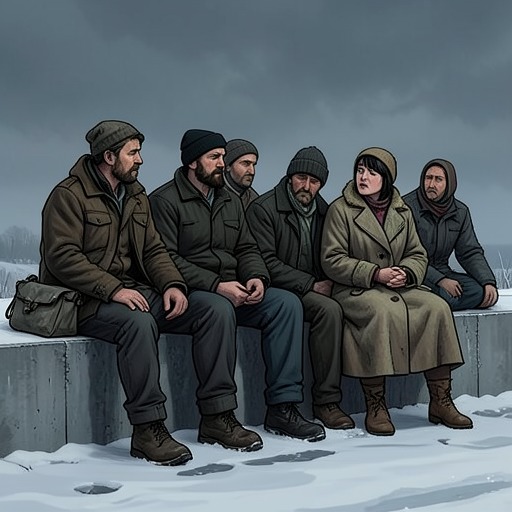
criminalization of homelessness
The Salt PathCriminalization of homelessness is the process by which people without secure housing are treated as threats to public order and subjected to arrest, fines, or displacement for conduct bound up with having nowhere to live. The book presents it not as a single law or isolated enforcement measure, but as a long-standing pattern: legal categories mark some people as suspicious, public-space rules can remove them from places where they shelter, and stigma helps make those actions seem acceptable. Against that pattern, the account sets both the scale of homelessness and the scarcity of alternatives to sleeping outside.
From suspicion to vagrancy law
The history begins with measures against begging and the classification of people without means as objects of public control. The Peasants’ Revolt was followed by the first Act against begging in 1381; further anti-vagrancy measures came in 1547 after The Dissolution of the Monasteries. As homelessness grew alongside the Enclosure Acts and the Industrial Revolution, legislation expanded. A 1744 Vagrancy Act categorized people as beggars, idle, vagabonds, and rogues, and branded repeat offenders incorrigible rogues. The book also notes that, since 1713, local authorities had been required to pay five shillings to anyone who apprehended an idle or disreputable person. That incentive contributed to abuse: more than five hundred people were arrested in a single year.
After homelessness increased again following the Napoleonic Wars, calls for stricter controls helped produce the Vagrancy Act 1824. Although amended over time, it remained partly in force when the book was written. Section One, used alongside the Criminal Justice Act of 1982, classifies as idle and disorderly a person who wanders or places themselves in a public place to beg or gather alms. Section Four extends the category of rogues and vagabonds to people lodging in barns, outhouses, deserted buildings, or the open air, including under a tent, when they have no visible means of subsistence and cannot give a good account of themselves. The reach of these provisions is striking: sheltering in an improvised place can itself become part of the language through which a homeless person is treated as an offender.
Public-space controls and penalties
A newer framework appears in the Anti-social Behaviour, Crime and Policing Act 2014, which took effect the year after the couple in the narrative first walked the South West Coast Path. Its Public Space Protection Orders allow authorities to require someone deemed a nuisance to leave an area and not return. The book gives examples of the breadth of such orders, including a Forest of Dean restriction on nuisance sheep and restrictions concerning carrying golf clubs in public. It argues that local authorities can use these powers to target conduct associated with homelessness, including rough sleeping, begging, and loitering.
The consequences can extend beyond being moved on. The account says an order may carry a £100 fine, with non-payment potentially bringing a £1,000 fine and a criminal record. These measures make access to public space conditional on official judgments about acceptable presence and behaviour. The concern is not simply that authorities intervene in particular cases, but that ordinary acts of survival can be recast as nuisances and met with penalties that a person without housing may be poorly placed to pay.
Statistics, stereotypes, and visibility
The legal picture is reinforced by a narrow public image of homelessness: a person sleeping on a pavement, perhaps with a dog, and assumed to be begging to support drug or alcohol use. The book argues that this stereotype shapes how passers-by respond, from discomfort to hostility, and obscures people whose housing insecurity does not look like street sleeping.
Statistics make that gap visible. Research by Crisis and the Joseph Rowntree Foundation found that in 2013 at least 280,000 UK households said they were homeless or at risk of becoming so. These were households that had applied for listing, not a head count of individuals. Officials accepted 52,000 as statutorily homeless; many of the other 228,000 received help through local-authority relief. Rough-sleeping estimates varied even more: the government recorded 2,414 people across England in a one-night snapshot, while the Homelessness and Information Network, funded by the Greater London Authority, counted 6,508 people sleeping rough in London during 2013. The government’s snapshot figure for London was 543. These measures describe different populations and use different methods, but the contrast shows how a limited count can make homelessness appear smaller and more manageable. People in informal arrangements, including sofa-surfers and those sleeping unseen, may not leave a record that brings them into official totals.
Housing exclusion and the search for shelter
The couple’s circumstances show why criminalization cannot be separated from the shortage of secure alternatives. After losing their home, they found that their damaged credit rating made renting exceptionally difficult. The campsite offer they could find cost £80 a week, more than they could afford, and housing benefit did not cover campsite fees. The council could place them on a waiting list, but they were low priority; the available immediate option was a bed-and-breakfast room in a building mainly used by people with drug and alcohol problems. They chose the tent rather than that placement. This account does not say that the couple were prosecuted under vagrancy law; it shows how people can be pushed towards insecure forms of shelter even as laws and orders make some of those forms vulnerable to control.
A forest camp described elsewhere in the book makes the same conflict concrete. The council wanted to remove a group sleeping in the woods to create a public-access space, while the people living there needed places to shelter safely overnight. Plans for new shelters offered ten beds here and ten there, but the homeless people discussing them considered that far from enough. The camp itself was a shifting community of tents, tarpaulins, and shelters made from fallen branches, with residents sharing food and a place to pitch. One resident had become homeless after the farm where he worked was sold and its tied cottages were separated from the land and bought as second homes. Subsequent jobs did not provide housing, and his wages could not meet rural rents. His account traces homelessness to housing and employment conditions, not to the stereotype that the homeless are inherently irresponsible or dangerous.
The book’s critique
The book challenges the assumption that addiction or mental-health problems explain homelessness in every case. It acknowledges that these problems are common in the homeless community, while stressing that they may result from homelessness as well as precede it. Fear of homeless people, and concern about tourism, can then justify measures that remove them from view rather than provide somewhere to stay. The narrative asks whose need is considered valid: whether a person must be fleeing war to be recognized as deserving shelter, or whether people made homeless in their own country receive the same regard.
That question links enforcement to social visibility. A single person sleeping in a doorway is easy to stereotype and count selectively; households, people moving between temporary arrangements, and communities sheltering in woods are harder to fit into official categories. The narrative’s image of more than 280,000 households as refugees from western civilization turns the usual distinction between displaced outsiders and local homeless people against itself. In this account, criminalization is not only a matter of what the law prohibits. It also describes a public response that can prioritize clear, orderly spaces over safe shelter, while the people displaced remain difficult to see and insufficiently counted.